

Scary story video ideas for TikTok and YouTube Shorts
30 scary story video ideas for faceless TikTok and YouTube Shorts channels, plus how to write the hook, pick a look and voice, and keep it under a minute.
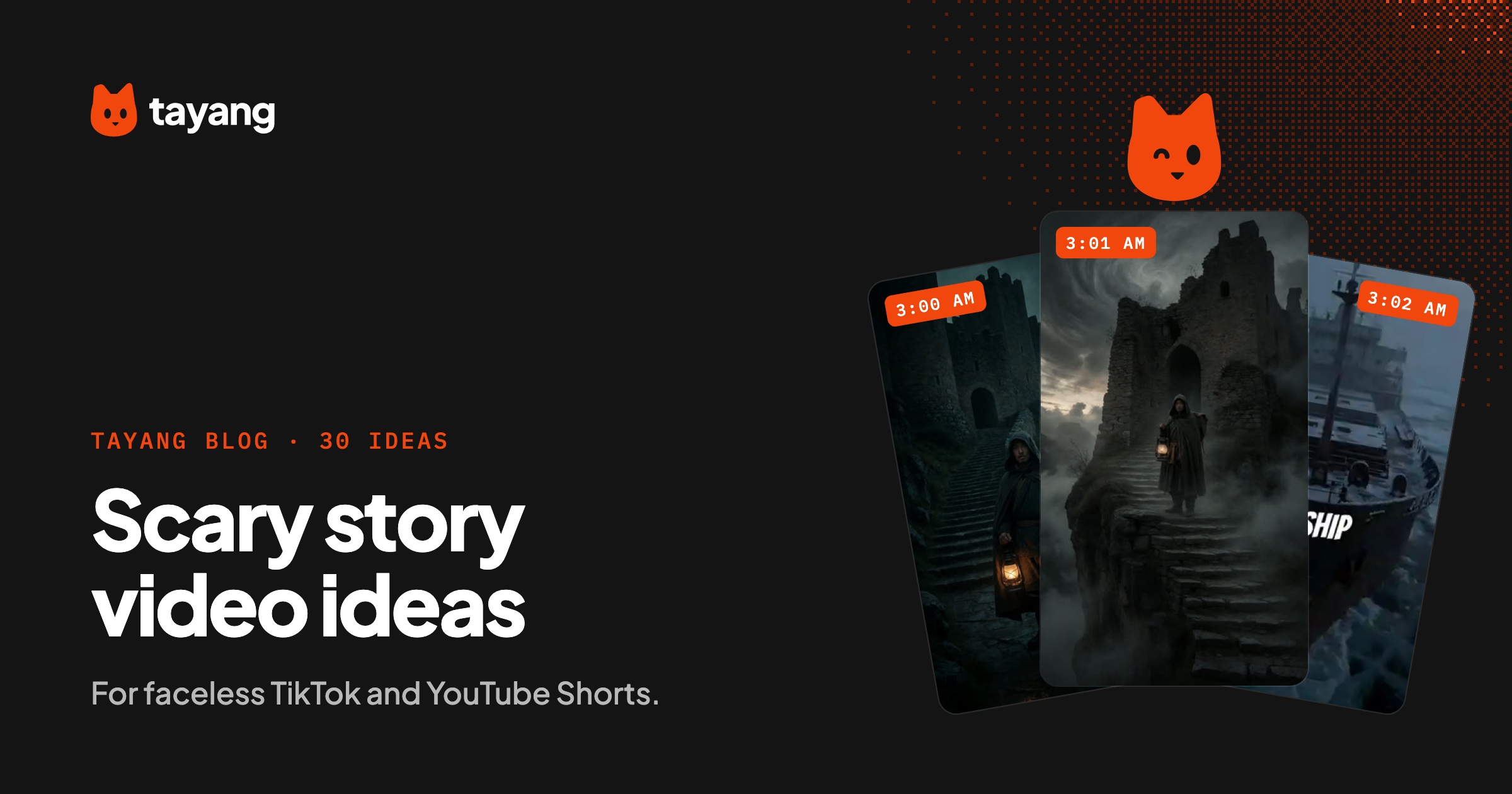
The best scary story video ideas for TikTok and YouTube Shorts are ordinary situations with one wrong detail: a rule that makes no sense, a sound that shouldn't be there, a message from someone who can't have sent it. They can be set up in one sentence and paid off in under a minute. Below are 30 ideas sorted by type, then how to turn any of them into a faceless short that people watch to the end.
New to faceless video? Start with how to make faceless AI videos, then come back for ideas.
Why scary stories work as faceless shorts
- The hook is built in. "I found a second door in my apartment" makes people stay to find out what's behind it.
- They don't need a face. A low voice, dark illustrations and captions do the work.
- Endless topics. Every house, job and late-night drive can hide a story.
- Twist endings get rewatched. Viewers go back to catch the clue they missed.
30 scary story video ideas
All of these are original prompts. Use them as starting points, change the details and make them your own.
Strange rules
- A babysitting job with one rule: never answer the landline after 10 p.m.
- The night-shift manual at a gas station has a page that says "If he asks for the restroom key, say it's broken."
- A hotel tells guests to keep their curtains closed on the 4th floor. There is no 4th floor button in the elevator.
- Your new roommate's note on the fridge: "Don't let it know you can hear it."
- A campground sign: "If someone calls your name from the trees, don't answer, even if it sounds like you."
Messages and calls
- A voicemail from your own number, recorded tomorrow.
- Your late grandmother's phone texts the family group chat: "Who's in my room?"
- A wrong-number call where the caller describes exactly what you're wearing.
- Your smart speaker plays back a recording you never made.
- A delivery app shows your driver arriving. You live alone. They've arrived "inside".
Houses and rooms
- The neighbor who only knocks at 3 a.m.
- A locked room in your grandmother's house that's warmer than the rest.
- Renovating your apartment, you find a second, older doorbell wired to nothing.
- The previous tenant left a list of "noises that are normal". One of them isn't on it.
- The baby monitor picks up a second, older voice singing to your child.
Night travel
- The last bus that never stops at your stop, but always slows down.
- A highway rest stop that only appears on the drive home.
- Your GPS keeps routing you to an address that isn't on any map.
- A hitchhiker who knows your name and where you're going.
- A taxi driver who keeps checking the mirror, and not at you.
Jobs and places
- A museum night guard notices one portrait changes expression every night.
- A lifeguard at an empty pool hears splashing after closing.
- A forest ranger's radio picks up a call from a tower that burned down years ago.
- A hospital porter is sent to collect a patient from a ward that closed.
- A lighthouse keeper's logbook has entries in his handwriting from before he arrived.
Twists and loops
- You find a missing-person poster with your face on it, dated next week.
- A stranger hands you a photo of yourself asleep, taken last night.
- The scary story you're telling turns out to be happening to the listener.
- Every night at the same time, someone knocks twice. Tonight it knocked three times.
- You wake up, check the time, and it's the same minute you fell asleep. Again.
How to turn an idea into a 60-second short
Write the hook first
Your first sentence is the whole pitch. State the wrong detail immediately:
- Weak: "So this happened to me last year when I got a babysitting job."
- Strong: "The parents had one rule: never answer the landline after 10 p.m."
Use a simple shape
- Hook: the rule, the sound or the message.
- Normal life: two sentences that make it feel real.
- Escalation: it happens again, closer or louder.
- Twist: the reveal that changes what came before.
- Last line: short, quiet, chilling. Then stop.
At a steady narration pace, 60 seconds is roughly 130–160 words. That's a rule of thumb, but it keeps you honest: if the script is 300 words, it's two videos.
Write in first person
"I" stories feel like confessions, and confessions feel true. Keep the narrator unnamed so viewers can put themselves in the story.
End on the twist, not an explanation
Don't explain the ghost. The scariest version leaves one question open, which also gets people commenting their theories.
Visuals, voice and sound
- One dark art style for the whole channel, such as painterly, grainy or cinematic. Viewers should recognize your video before they read the caption.
- One image per beat. Show the door, then the hand, then the empty hallway.
- A low, slow narrator. Pauses before the twist matter more than the voice itself.
- Quiet drones, not jump-scare stings. Tension holds attention better than noise.
- Word-by-word captions so the story works on mute, kept clear of the platform buttons.
Rules to follow
- Keep it fiction. Don't present made-up stories as real crimes involving real, named people.
- Don't copy other creators' stories. Use the idea, write your own version.
- Mind the platform's rules on graphic content. Atmosphere and suggestion are scarier than gore anyway, and they keep your videos within the rules.
Posting a scary story every day
One video won't grow a channel. A new story every day for weeks gives the algorithm enough to work with. Our guide on starting a faceless YouTube channel with AI covers setup and posting.
If you'd rather not write, illustrate and edit every night, Tayang's scary stories series does it for you: a new story each day, illustrated in a dark style, narrated with word-by-word captions and music, and posted to TikTok, YouTube Shorts, Instagram Reels and Facebook Reels, with or without your approval first.