

Science video ideas for TikTok and YouTube Shorts
30 everyday science video ideas for faceless TikTok and YouTube Shorts channels, from why ice floats to why onions make you cry, plus how to explain them.
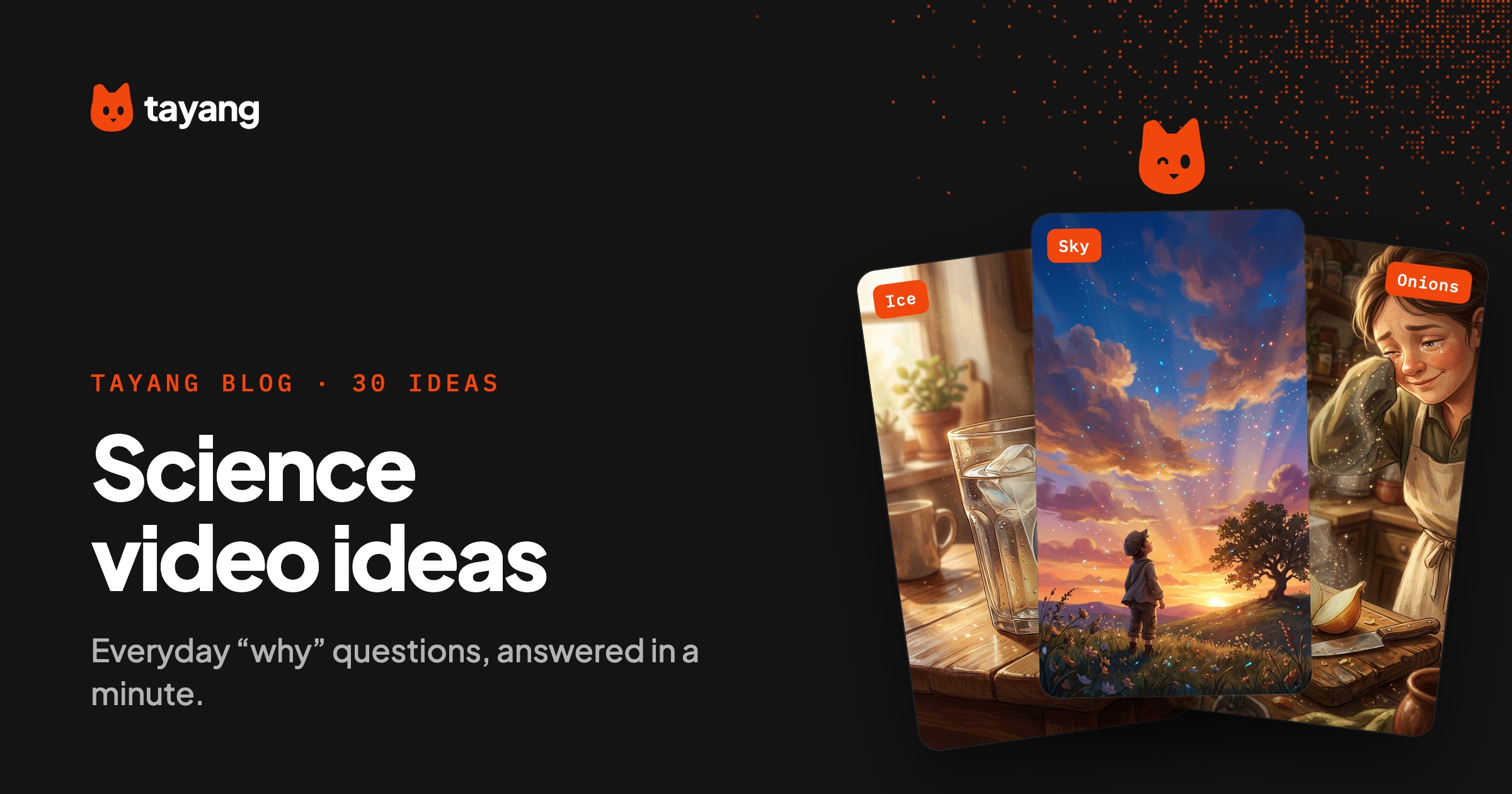
The best science video ideas for TikTok and YouTube Shorts answer a "why" question people have wondered about but never looked up: why ice floats, why onions make you cry, why bread goes hard. Each has a clear answer you can explain in under a minute with one good picture. Below are 30 ideas, then how to script and illustrate them for a faceless channel.
New to faceless video? Start with how to make faceless AI videos.
Why everyday science works as short videos
- The question is the hook. "Why does ice float?" makes people want the answer.
- Everyone can relate. The kitchen, the sky and the human body are things every viewer knows.
- It's evergreen. A good explanation is still useful in five years.
- It's easy to show. A simple diagram usually explains more than a paragraph.
30 everyday science video ideas
Check every explanation against a reliable source, such as a university or science museum page. Many popular explanations are simplified or wrong.
In the kitchen
- Why ice floats. Most solids sink in their own liquid; water's frozen form is less dense.
- Why onions make you cry. Cutting them releases a compound that irritates your eyes.
- Why bread goes stale. It's not mainly drying out: the starch slowly changes structure.
- How popcorn pops. Water inside the kernel turns to steam until the shell bursts.
- How a microwave heats food. And why it heats unevenly.
- Why salt melts ice on roads.
- Why pasta water boils over but plain water doesn't.
- Why chopped apples turn brown.
Your body
- Brain freeze. Why cold food can cause a sudden headache.
- Why fingers wrinkle in water. It's controlled by your nerves; one leading idea is that it improves grip.
- Why you yawn. Scientists still debate it, which is a good hook in itself.
- Why you can't tickle yourself.
- Why your stomach growls.
- Hiccups. What's actually happening.
- Goosebumps. A leftover from ancestors with more body hair.
The sky and the weather
- Why the sky is blue. Air scatters blue light more than red.
- Why sunsets are red. Same reason, more air in the way.
- Why you see lightning before you hear thunder.
- How rainbows form.
- Why clouds float even though they're made of water.
Things around the house
- How noise-cancelling headphones work. They play sound to cancel sound.
- Why a mirror flips left and right but not up and down.
- How a fridge keeps food cold without making cold.
- Why metal feels colder than wood at the same temperature.
- How a touchscreen knows where your finger is.
Myths worth busting
- The tongue map. Your whole tongue can taste every basic taste.
- "We only use 10% of our brain." We use far more than that.
- Goldfish have three-second memories. They don't.
- Lightning never strikes the same place twice. Tall buildings get hit repeatedly.
- Bulls hate the color red. It's the movement of the cape that provokes them.
How to explain science in 60 seconds
Ask the question first
The first line should be the question, or a surprising version of it:
- Weak: "Today let's talk about density."
- Strong: "Almost every solid sinks in its own liquid. So why does ice float?"
Use a simple shape
- Hook: the question.
- The wrong answer most people assume, if there is one.
- The real answer, in plain words.
- One picture that makes it click: molecules, a diagram, a cut-away.
- A last line that connects back to everyday life. Then stop.
At a steady narration pace, 60 seconds is roughly 130 to 160 words. That's a rule of thumb; science scripts especially tend to run long, so cut jargon first.
Be accurate, and say when science isn't sure
Some questions, like why we yawn, don't have a settled answer. Saying "scientists still aren't sure, but the leading idea is..." is honest and makes a good hook. Viewers who know the subject will correct real mistakes in the comments.
Visuals, voice and music
- Warm, simple illustrations work better than realistic footage. One idea per scene.
- Cut-aways and arrows: show what's happening inside the ice cube, the eye, the fridge.
- A friendly, curious narrator. Like a good teacher, not a lecture.
- Light, upbeat music kept low.
- Word-by-word captions so it works on mute.
Related niches
Science viewers often like blueprint explainers, which show how machines work, and geography. They're natural second channels.
Posting a science video every day
Channels grow on consistency. Tayang's everyday science series makes a new explainer each day, illustrated in warm scenes, narrated with word-by-word captions and music, and posted to TikTok, YouTube Shorts, Instagram Reels and Facebook Reels, either after you approve it or on its own.