

True crime video ideas for TikTok and YouTube Shorts
30 true crime video ideas for faceless Shorts and TikTok: famous heists, con artists, unsolved mysteries and cases cracked by tiny details.
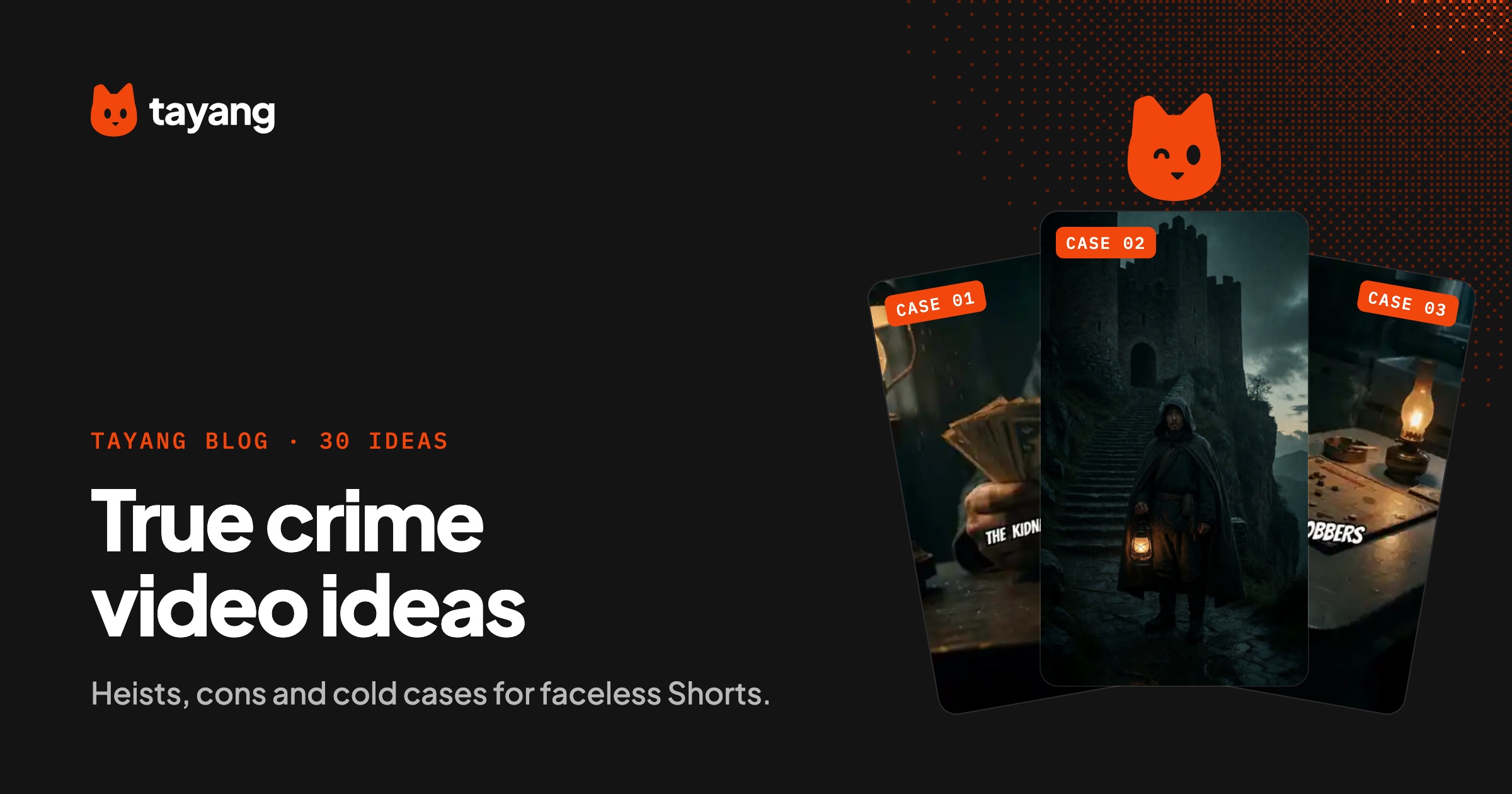
The best true crime video ideas for TikTok and YouTube Shorts are famous heists, cons and mysteries with one detail so strange it makes people stop scrolling: a hijacker who vanished with the ransom, empty frames still hanging in a museum, robbers who played Monopoly with real money. These cases fit in under a minute and don't depend on graphic violence. Below are 30 ideas sorted by type, then how to script them responsibly for a faceless channel.
New to faceless video? Start with how to make faceless AI videos, then come back for ideas.
Why true crime works as faceless shorts
- The mystery is the hook. "He jumped out of a plane with $200,000 and was never identified" makes people stay to the end.
- It illustrates without a face. Vaults, getaway cars, case files and night streets carry the story.
- There's an endless supply, going back centuries.
- People argue in the comments. Unsolved cases get theories, and comments help a video spread.
30 true crime video ideas
These are real cases. Details vary between retellings, so check each one against reliable sources before you script it.
Heists
- The D. B. Cooper hijacking (1971). A man hijacked a plane, collected a ransom, parachuted out over the Pacific Northwest and was never identified.
- The Isabella Stewart Gardner Museum theft (1990). Thieves dressed as police officers took 13 works of art. The empty frames still hang in the museum.
- The Mona Lisa theft (1911). A museum worker walked out of the Louvre with it. The theft helped make it the world's most famous painting.
- The Antwerp diamond heist (2003). Thieves got into a vault protected by layers of security, and were caught partly because of a half-eaten sandwich and some rubbish left by a road.
- The Great Train Robbery (1963). The gang's hideout was found with fingerprints on a Monopoly board they'd played with real stolen money.
- The Baker Street robbery (1971). Thieves tunneled into a London bank vault while a radio amateur overheard their walkie-talkie chatter.
- The Banco Central tunnel (2005). In Fortaleza, Brazil, thieves ran a fake landscaping business as cover while they dug a tunnel to the bank.
- The Brink's-Mat robbery (1983). Robbers expected cash and found tonnes of gold bullion, which then had to be melted and sold.
- The Lufthansa heist (1978). A cash robbery at JFK airport, later shown in the film Goodfellas.
Con artists
- Victor Lustig sold the Eiffel Tower. He convinced a scrap dealer that Paris was selling it for scrap, and by most accounts tried to do it twice.
- Charles Ponzi (1920). The man whose name is now used for a whole type of fraud.
- "Selling the Brooklyn Bridge". Con men like George C. Parker were said to have sold it to newcomers.
- Ferdinand Waldo Demara, "the Great Impostor". He posed as a ship's surgeon in the Korean War, among many other careers he wasn't qualified for.
- Frank Abagnale's story. The con man from Catch Me If You Can, whose own account has since been seriously questioned by researchers. A con about a con.
- Anna Sorokin, "Anna Delvey". A fake heiress who fooled New York banks and hotels, and was convicted in 2019.
Mysteries
- The Mary Celeste (1872). A ship found sailing with no one on board and its cargo almost untouched.
- The Flannan Isles lighthouse keepers (1900). Three keepers on a remote Scottish island disappeared without a trace.
- The Somerton Man (1948). A man found dead on an Australian beach with a scrap of paper reading "Tamam Shud". Researchers named him decades later.
- The Zodiac ciphers. One of the killer's coded messages went unsolved for 51 years, until amateur codebreakers cracked it in 2020.
- Jack the Ripper (1888). Why a case with so many suspects has never been closed.
Caught by one small detail
- The Lindbergh kidnapping ransom. Part of the ransom was paid in gold certificates, which the US was taking out of circulation, and that made spending them stand out.
- The floppy disk. The BTK killer was traced through metadata on a disk he sent to police.
- Genetic genealogy and the Golden State Killer (2018). How DNA uploaded by distant relatives to a genealogy site cracked a decades-old case.
- Silk Road. An early forum post linked to the founder's personal email helped investigators find him.
- The getaway that went wrong. Pick any heist above and tell it only from the moment it started to fall apart.
Escapes
- Escape from Alcatraz (1962). Three men left papier-mâché heads in their beds and were never found.
- John Dillinger's wooden gun (1934). He escaped from jail by, according to most accounts, threatening guards with a fake gun.
- The Pink Panthers. An international jewel theft network known for fast, daring robberies.
- The Great Escape (1944). Prisoners of war dug tunnels out of Stalag Luft III. Not a crime, but it fits the format.
- Pablo Escobar's prison. He agreed to go to jail on condition he could build his own, called La Catedral, then walked out of it.
How to tell true crime responsibly
True crime is about real people. A few rules keep your channel fair, and keep it within platform rules on violent content:
- Focus on the case, not the gore. Heists, cons and mysteries need no graphic detail. For violent crimes, stick to the investigation.
- Remember the victims. Use their names with respect, or not at all. Never mock them.
- Separate fact from theory. Say "police believed", "one theory is" or "he was never charged" where that's the truth.
- Don't name living people as suspects unless they were charged or convicted, and say which.
- Be careful with recent cases. Families are still living with them. Older, well-documented cases are safer and often more interesting.
How to turn an idea into a 60-second short
Lead with the strangest detail
- Weak: "In 1990, the Isabella Stewart Gardner Museum in Boston was robbed."
- Strong: "In this museum, 13 empty frames still hang where stolen paintings used to be."
Use a simple shape
- Hook: the strange detail.
- The setup: who, where and when, in two sentences.
- The crime: what happened, in order.
- The twist: how they were caught, or why no one ever was.
- Last line: an open question or a short fact that lands.
At a steady narration pace, 60 seconds is roughly 130 to 160 words. That's a rule of thumb; if your script runs longer, make it a two-part video.
Visuals, voice and sound
- One dark, cinematic art style for the whole channel.
- Objects tell the story: the ransom note, the vault door, the map of the escape route.
- A low, steady narrator. Let facts be dramatic on their own.
- Tense, quiet music under the voice.
- Word-by-word captions, with dates and names held on screen.
Related niches
True crime audiences also watch scary stories and history. See our scary story video ideas and history video ideas.
Posting a true crime video every day
One video won't grow a channel. A new case every day for weeks gives TikTok and YouTube enough to learn who your audience is. Our guides to starting a faceless TikTok account and starting a faceless YouTube channel with AI cover setup and posting.
If you'd rather not research, illustrate and edit every night, Tayang's true crime series does it for you: a new case each day, illustrated in the style you pick, narrated with word-by-word captions and music, and posted to TikTok, YouTube Shorts, Instagram Reels and Facebook Reels, with or without your approval first.